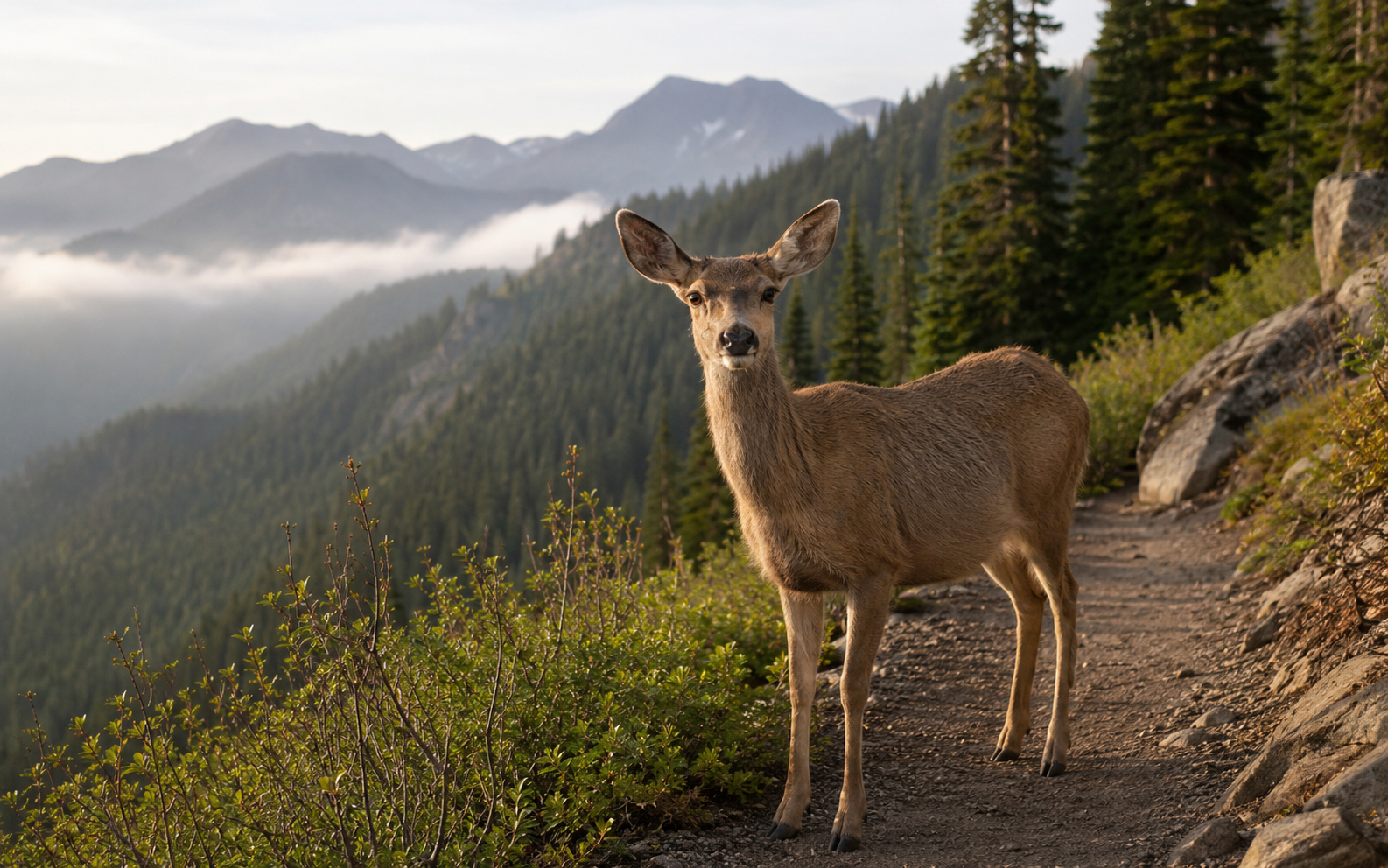
You round a bend in the trail and there it is — a deer, standing perfectly still thirty metres ahead, watching you with an expression that's equal parts curiosity and caution. For a few seconds, neither of you moves. Then it turns and disappears into the undergrowth with a silence that seems impossible for something that size. That moment — brief, unscripted, entirely on the animal's terms — is one of the best things about mountain hiking.
What You're Likely to See
The species you encounter depend entirely on where you're hiking. In the Appalachians, white-tailed deer, black bears, wild turkeys and red-tailed hawks are common. In the Rockies, you might spot elk, marmots, pikas and — if you're exceptionally lucky — a mountain lion at distance. European mountains offer chamois, ibex, golden eagles and the occasional lynx track in soft ground.
Most wildlife encounters happen early in the morning or late in the afternoon, when animals are feeding. Mid-day heat pushes them into shade and cover. If you want to see wildlife, start your hike at dawn and move quietly. The National Park Service trail guides are excellent resources for understanding what lives in specific regions and when you're most likely to spot it.
How to Behave
The golden rule is simple: you are a guest in their home. Keep your distance — at least 25 metres from most animals, 100 metres from bears and wolves. Use binoculars rather than your feet to get a closer look. Never approach, feed or attempt to touch wildlife. A deer that associates humans with food becomes a deer that approaches cars, campsites and roads — and that rarely ends well for the deer.
If you encounter a bear, stay calm. Make yourself visible, speak in a low steady voice, and back away slowly. Do not run. Do not climb a tree. In most cases, the bear will move on. Bear encounters that go wrong almost always involve surprise at close range — which is why making noise on the trail (talking, clapping, using a bell) is standard practice in bear country.
The Ethics of Wildlife Photography
Everyone wants the photo. The problem is that getting the photo often means getting too close. Telephoto lenses exist for a reason. A decent 200mm lens or a smartphone adapter will let you capture a sharp image from a respectful distance. If you're close enough to fill the frame with a phone camera, you're too close.
Drone photography is a particular problem in mountain environments. The noise disturbs nesting birds and can cause panic in herds of grazing animals. Many national parks and wilderness areas have banned drones entirely, and for good reason. The photo isn't worth the stress you're causing an animal that can't tell the difference between a drone and a predator.
Why It Matters
Every respectful wildlife encounter reinforces the case for keeping wild places wild. Every irresponsible one — the too-close selfie, the fed chipmunk, the drone over a nesting eagle — chips away at the argument for coexistence. Mountain wildlife doesn't exist for our entertainment. It exists because these ecosystems function, and our job as visitors is to keep them functioning. Watch from a distance. Take the photo with a long lens. And walk away grateful that, for a moment, you were allowed to see something wild doing what it does best — being wild.